Every organisation already holds the information it needs to direct its work. It sits in the sales system, the operations records, the finance spreadsheets and the customer enquiries. Business intelligence brings that information together, so that the people who make decisions see one accurate picture, refreshed without manual effort.
Begin with the decisions
A dashboard is only as useful as the decisions it supports. Before any data is connected, we establish which decisions it is for, who makes them, and how often. A director reviewing performance each month needs something different from a supervisor managing the day’s workload, and each should see the measures that matter to their role.
Bring the data together, and define each measure once
Most organisations hold their data in several systems that were never designed to work together. We connect to each source, bring the data into one place on a schedule, and reconcile it, so that a customer, an order or a branch means the same thing everywhere.
Each measure is then defined once, in writing, and agreed with the people who own it. When the definition of an on-time delivery or an active customer is settled and documented, every report that uses it agrees, and the discussion moves from whose figure is correct to what the figure means.
Design for the people who use it
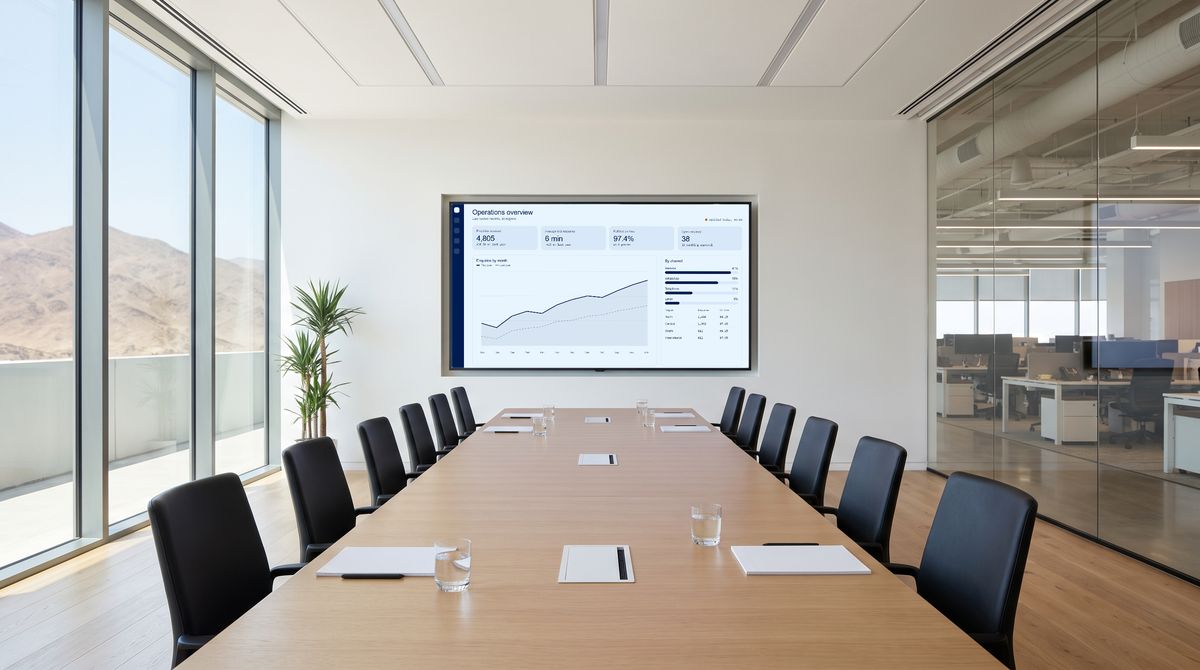
A well-designed dashboard shows a few measures clearly and keeps the detail one step away. Each view is built for a role, presents its main measure first, and lets the user move from a summary to the records behind it. Reports that are needed on a fixed schedule are produced and distributed automatically.
Built around your organisation
Because every organisation measures its work differently, we design and build business intelligence around its own data, measures and decisions rather than a fixed template. Depending on the systems already in place, dashboards can be built on an established business intelligence platform or delivered within your own web platform, with access controlled by role.
Operated, not only delivered
Data sources change, systems are upgraded and new questions arise. We monitor every scheduled refresh, correct issues as they occur, and extend the dashboards as the organisation’s needs develop, under the same service agreement as the rest of the system.
A typical engagement: an operations dashboard that combines enquiries, orders and service records from several systems and is refreshed every morning.
More insights
-
What happens to a system after launch
Why the service that follows launch matters as much as the build, and why the engineers who built a system should run it.
Read the article -

Where an AI agent helps with customer enquiries, and where a person stays in charge
What an AI agent handles well, the decisions that should remain with your staff, and how the handover between them should work.
Read the article
A structured assessment of your current systems and requirements, concluding in a written plan.